Millionaire Migration 2026: Where the World's Wealth Is Moving
Millionaire Migration in2026: Where the World's Wealth Is Moving
Global wealth mobilityhas become one of the clearest signals of where capital feels safe, welcome andpositioned to grow. Two flagship studies — the Henley & Partners PrivateWealth Migration Report 2026 and Knight Frank's European relocation research —point to the same conclusion: millionaire relocation is accelerating, and primeproperty markets are absorbing that capital in very specific places.
Wealth mobility reaches arecord high
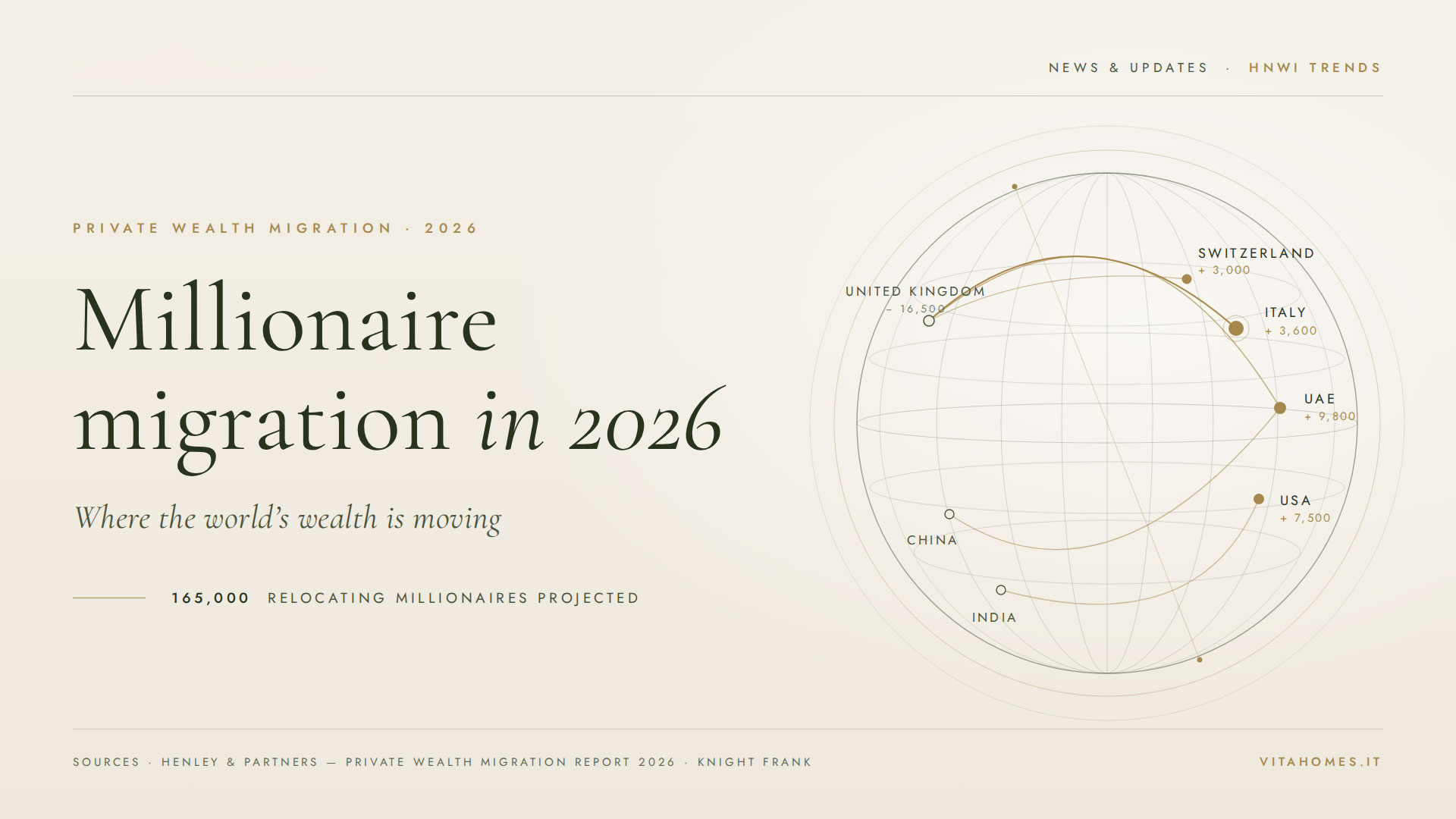
The number ofrelocating millionaires has climbed steadily, from roughly 120,000 in 2023 toabout 142,000 in 2025, with projections pointing toward 165,000 in 2026,according to Henley & Partners. The firm frames this as a structural changerather than a passing trend: for globally mobile families, moving tax residencyis increasingly treated as a deliberate portfolio decision rather than aone-off lifestyle choice.
Where the wealth is goingin 2026
Net inflows in 2025concentrated around a handful of destinations that combine fiscal clarity,stability and lifestyle:
– United Arab Emirates — the top destination for the secondconsecutive year, with an estimated 9,800 incoming millionaires and around USD63 billion in wealth inflow.
– United States — roughly 7,500 net arrivals, still the world'slargest private-wealth market even as it also generates high outbound demand.
– Italy — approximately 3,600 arrivals, driven by its flat-taxregime for new residents (raised to €300,000 from January 2026) and bydepartures from the UK.
– Switzerland — around 3,000, anchored in private banking and itslump-sum tax arrangement.
– Saudi Arabia — around 2,400, an emerging destination under itsVision 2030 agenda, with Singapore, Portugal, Greece, Canada and Australiacompleting the top ten.
Where the wealth isleaving
The United Kingdomrecorded the largest net outflow in the report's history — a direct consequenceof the 2024–2025 reform that replaced the long-standing non-dom regime with ashort tax-free window followed by worldwide taxation. Henley & Partners estimatesthat around 4,000 UK company directors alone departed in the year following thechange. China, India, South Korea, Russia, France, Germany and Brazil alsoregister meaningful outflows, though India's departures are moderating as itsdomestic wealth base matures.
Beyond raw numbers: a newway to score destinations
The 2026 reportintroduces a Global Wealth Mobility Framework that scores jurisdictions acrosstwelve weighted dimensions — including tax treatment, rule of law, quality oflife and geopolitical stability — rather than ranking countries by inflowalone. Singapore currently leads that competitiveness index, reinforcingSoutheast Asia and the Gulf as the two dominant magnets for mobile wealth,ahead of several traditional Western hubs.
Europe's enduring pull
Knight Frank's researchadds texture to the picture: a large share of surveyed HNWIs worldwide —roughly 46% — are actively considering a move to or within Europe, drawn byfavourable taxation, cultural depth, political stability and climateresilience. Lisbon, London, Madrid, Dublin and Barcelona rank among the mostsought-after relocation cities, while Tuscany, the Algarve, the Balearics andAlpine hubs such as Chamonix and Verbier remain the leading non-urban draws.Notably, Knight Frank describes an urban revival among the wealthy after yearsof resort-led demand, with privacy and cultural vibrancy now competing directlywith pure seclusion.
Why this matters for primereal estate
The link betweenmigration and property is direct: HNWIs rarely relocate without moving capitalinto real assets. When wealthy individuals move, they typically bringcompanies, family offices and property demand with them — which is whynet-inflow markets such as the UAE, the US, Italy and Switzerland are alsorecording the strongest prime real-estate resilience. For buyers and advisors,the practical lesson is to track policy as closely as price: golden-visaclosures, route withdrawals and non-dom reforms are reshaping demand fasterthan economic fundamentals alone would predict.
The era of the 'portfolioof jurisdictions'
Perhaps the mostimportant shift is behavioural. Rather than betting on a single relocation,HNWIs increasingly hold residence and property rights across multiple countries— tax efficiency in one, lifestyle in another, stability in a third. In thatmodel, a residence is not just a home; it is a considered position within awider strategy. Italy, with its heritage landscapes and its flat-tax gateway,is becoming one of the most compelling pieces of that portfolio.
Discover what VitaHomes isbuilding next
The philosophy behindevery VitaHomes residence is the faithful restoration of Italy's builtheritage, paired with contemporary living and a complete ecosystem of servicesthat makes ownership effortless. Explore our upcoming projects and see howheritage becomes home.
Sources &disclaimer. Figures cited are drawn from the Henley & Partners PrivateWealth Migration Report 2026 and Knight Frank's European relocation research.This article is provided for general information only and does not constitutetax, legal or investment advice.
More news
View all
Prime European Property in 2026: Buyer Shifts, Currency and Luxury Trends
Europe's prime residential markets are being reshaped by three forces at once: a changing mix of international buyers, the quiet but powerful influence of currency, and an evolution in what wealthy purchasers actually want from a home. Drawing on Knight Frank's July 2026 European research and Sotheby's International Realty's luxury outlook, here is how the picture looks.
Heritage as a Working Asset: Restoring Historic Italian Estates in 2026
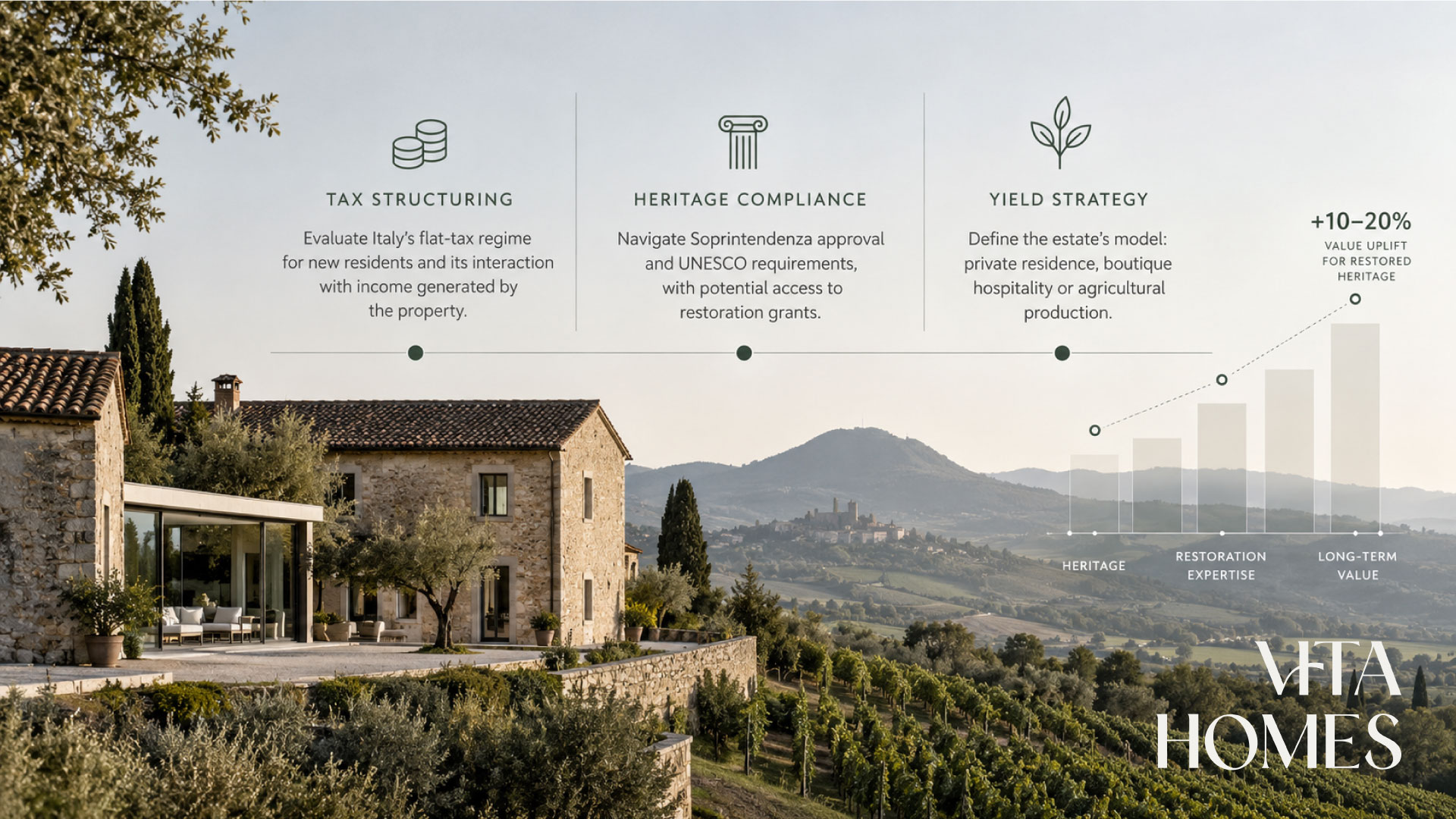
The most significant shift in Italian heritage property in 2026 is not about price — it is about purpose. Historic estates are no longer bought purely as private retreats. Increasingly, restoration is framed as an entrepreneurial strategy as much as an aesthetic one, and that changes everything about how these properties are chosen, restored and owned.

contact us
.avif)