What Is Luxury Today?
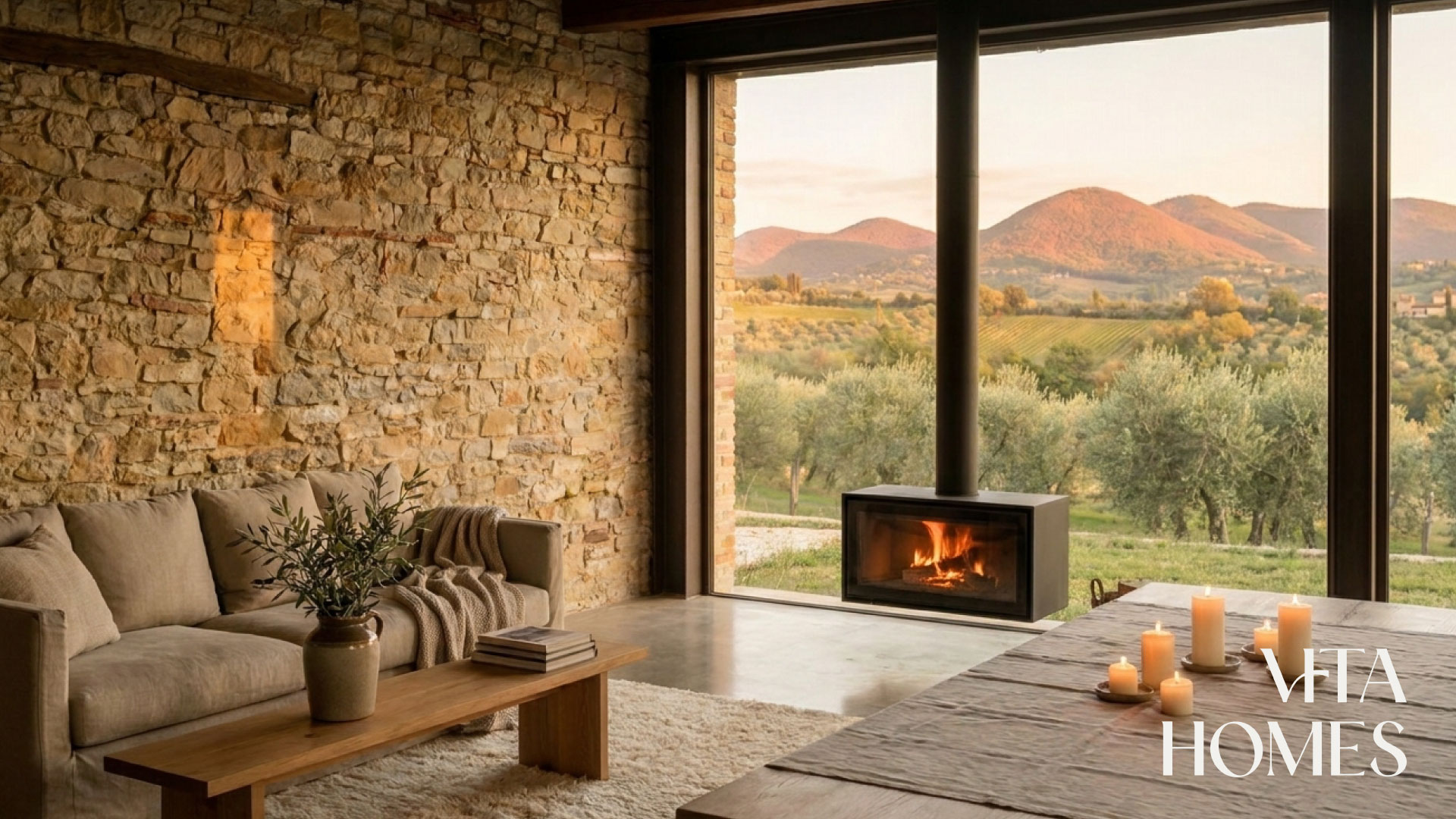
Every listing calls itself luxury. Every hotel lobby, every kitchen appliance, every airport lounge. When a word is applied to everything, it describes nothing. And yet the people who actually buy at the top of the market have not become vaguer about what they want. They have become far more specific. The vocabulary inflated while the idea narrowed.
What follows is an attempt to say what the idea has narrowed to.
The shift is measurable
The global luxury market is no longer growing the way it did. Bain & Company and Altagamma put total luxury spending at €1,443 billion in 2025 and expect 2026 to land roughly flat, between €1,440 and €1,470 billion. Personal luxury goods — the bags, the watches, the objects — account for €358 billion of that, and have essentially stopped growing.
What is growing is everything that cannot be wrapped. Consumer sentiment toward experiences is outrunning sentiment toward tangible goods by a factor of 1.5 in 2026, and bookings for immersive dining and leisure rose 30% year on year. Inside the goods categories themselves, the same instinct shows up as a preference for connoisseurship over hype: buyers researching provenance, movement and maker rather than following a launch. As Bain’s Claudia D’Arpizio put it, the market is stabilising, "but this is not a return to the old rhythm, it is the emergence of a new one."
Knight Frank’s Wealth Report 2026 finds the same rotation in property. Wealthy buyers, it reports, are moving away from acquiring individual prestige addresses and toward flexible living models, international residences and long-term quality of life. Location decisions now turn on political stability, security, discretion and infrastructure rather than on aesthetics alone, and the house itself is understood as two things at once: a stable tangible asset and a personal retreat.
That is the whole shift in one sentence. Luxury has moved from the object you display to the condition you live in.
Luxury is now measured in subtraction
The luxuries that hold their value are increasingly defined by absence rather than addition: absence of noise, of crowding, of heat, of surveillance, of obligation, of the low hum of being reachable. Space, silence, clean air, dark skies, unhurried time. None of these can be bought retail, none can be manufactured on demand, and every one of them has become scarcer over the last decade.
The market has quietly repriced this. The Global Wellness Institute values wellness real estate — built environments designed and operated to support the health of the people in them — at $876 billion in 2025, on the way to $1.8 trillion by 2030, having grown at 23.5% a year since 2019 while global construction grew at 3%. Europe went from $48 billion to $205 billion over the same period. The fastest-growing market in the global top twenty was Italy, at 50.2% a year, now worth $21 billion.
Read past the category label and this is not really about spas and cold plunges. It is about houses that are still cool in August, quiet at three in the morning, bright in February, and built of materials that do not off-gas. Comfort, in other words — but comfort engineered rather than assumed.
What cannot be made again
The second half of the definition is provenance, and it is the half that resists imitation entirely.
A great deal of what is sold as scarce is scarce by decision: a limited run, a numbered edition, a waiting list. Nobody is producing more sixteenth-century villas. Nobody is planting a new four-hundred-year-old ilex avenue, or laying a cloister, or acquiring a view that a landscape constraint has protected in perpetuity. That kind of scarcity is structural. It cannot be increased in a good year, which is precisely why it behaves so well over long holding periods.
Provenance also shows up at the scale of the hand. Lime plaster that breathes and softens with age, Istrian stone that darkens at the threshold where people actually walk, chestnut beams, cocciopesto floors, joinery cut for one particular opening. These are the materials that improve with time rather than degrade — the opposite of a finish that looks perfect on delivery day and dated within five years. A house restored this way accumulates value in a literal sense: it ages into itself.
Effortlessness is the price of entry
None of the above survives if the house is exhausting to own. This is where the contemporary buyer is unsentimental, and the data is blunt about it: among international enquiries on the Italian market in the first half of 2026, more than 60% were for move-in ready homes, and appetite for major restoration projects is declining. Across the Italian prime segment, the priorities that recur are energy efficiency, outdoor space, and properties already renovated to a modern standard.
The romance of the ruin has not disappeared, but it has moved: buyers still want the beams and the vaults, they simply no longer want to spend four years and an unbounded budget getting to them. The luxury is a fully restored building that behaves like a new one — heating that reaches temperature before you arrive, water pressure on the third floor, insulation inside walls that look untouched, a garden with a maintenance plan and someone who executes it. Technology that is present and invisible. Service that anticipates.
The test is simple. You land on a Friday evening. Is the house ready, or is the house a project?
Discretion instead of display
The final change is tonal. The signals of expenditure that once did the work — the announcing gate, the performing lobby, the visible logo — now read as slightly off at the top of the market. Knight Frank’s language for it is substance over ostentation; the wider culture calls it quiet luxury; in a house it means that the quality is legible only to someone who knows where to look.
The proportion of a room. Where the light falls at five in the afternoon in November. The joint in the stonework. The fact that a garden was laid out by someone who thought about what would still be thriving in thirty years. None of this photographs loudly. All of it is felt within an hour of arriving, and none of it can be retrofitted by spending more.
Why Italy answers the brief
Italy’s advantage is that its luxury was never manufactured. It was inherited, and then maintained.
The country holds an unusual concentration of exactly what the new definition asks for: buildings conceived before mechanical cooling existed and therefore designed to work without it — thick masonry, internal courtyards, loggias, cross-ventilation, orientation chosen for the summer sun; landscapes protected by constraint rather than by fashion; craft traditions still practised by people who can be hired; and an everyday texture — the market, the walk, the table, the long lunch — that supplies the unhurried time the definition is really about. Passive comfort in Italy predates the vocabulary we now use to sell it.
The buyers have noticed. International purchasers account for roughly 35% of the Italian prime market and 52% of it in central Italy, with the United States now generating more than a fifth of all foreign enquiries, ahead of the United Kingdom and Germany. And their intent is shifting in a way that matters: a growing share are looking for extended-stay residences rather than holiday houses. Not a place to visit for two weeks in August, but a second base, occupied for months, with a life attached to it.
A working definition
So: what is luxury today?
It is time you get back rather than time you spend maintaining. Space you are not obliged to share. Air, light and silence at a quality that is not for sale on any open market. Provenance that cannot be reproduced at any price, because the century that produced it has closed. And the ease that makes all of it usable — the house that works, so that you don’t have to.
Everything else is decoration. Decoration is enjoyable, and we are not against it. But it is no longer what people are buying at this level, and it has not been for some time.
At Vita Homes we work at the point where these things meet: Italian houses with histories that cannot be replicated, restored and equipped to be lived in without effort, for people who have understood that the rarest asset in the portfolio is a quiet morning.
Sources
— Bain & Company / Altagamma, Luxury Goods Worldwide Market Study — press release, June 2026.
— Knight Frank, The Wealth Report 2026 (20th edition).
— Summary of the Wealth Report 2026 luxury-preference findings (Ginesta).
— Global Wellness Institute, Wellness Real Estate Market Reaches $876 Billion — Forecast to Hit $1.8 Trillion by 2030, 2026.
— Gate-away.com, Foreign Buyers: A Snapshot of the Italian Property Market in the First Half of 2026.
— idealista, Luxury property market 2026 trends in Italy (citing Engel & Völkers Italia, Market Report Italia), April 2026.
More news
View all
Prime European Property in 2026: Buyer Shifts, Currency and Luxury Trends
Europe's prime residential markets are being reshaped by three forces at once: a changing mix of international buyers, the quiet but powerful influence of currency, and an evolution in what wealthy purchasers actually want from a home. Drawing on Knight Frank's July 2026 European research and Sotheby's International Realty's luxury outlook, here is how the picture looks.
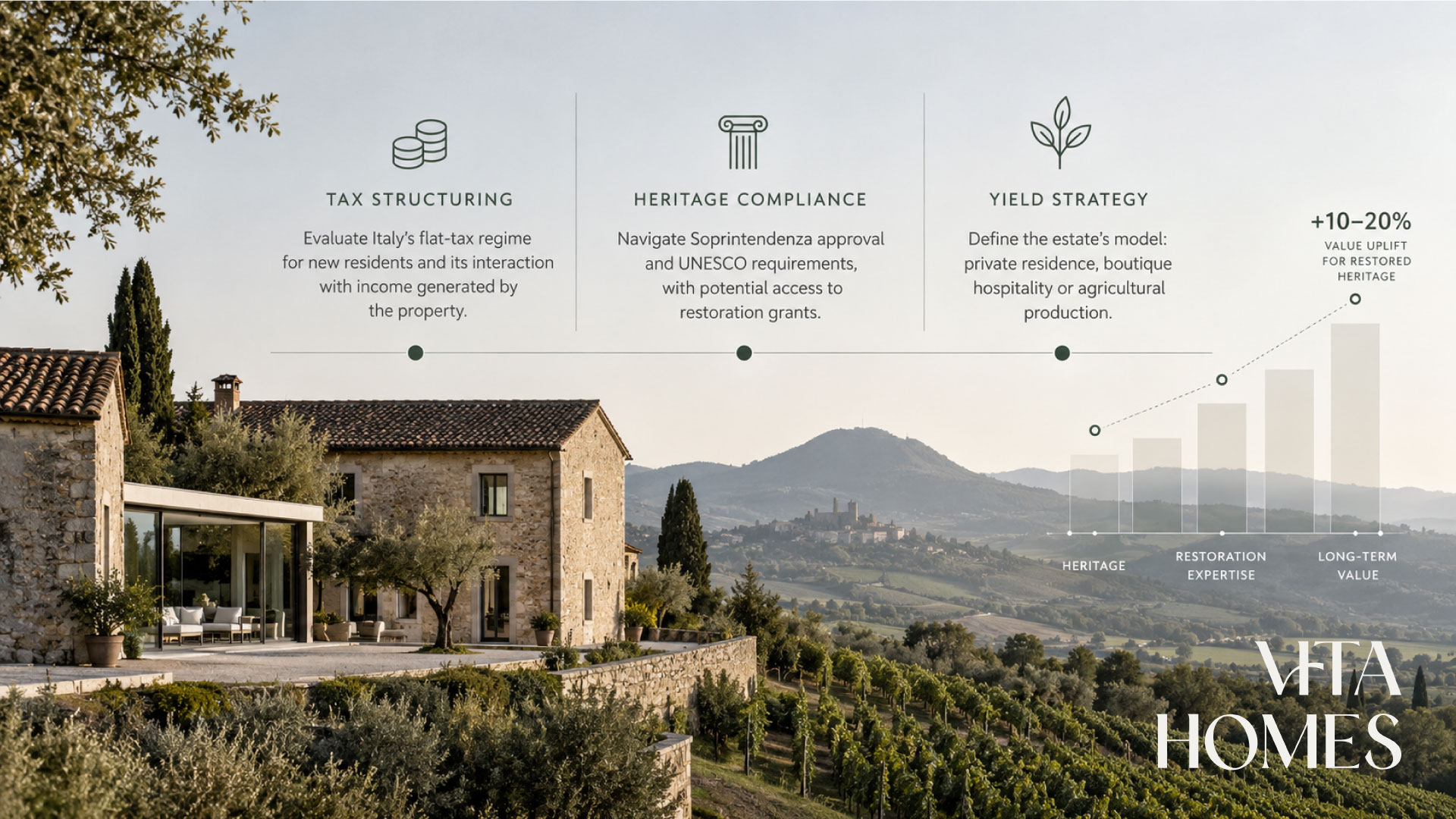
Heritage as a Working Asset: Restoring Historic Italian Estates in 2026
The most significant shift in Italian heritage property in 2026 is not about price — it is about purpose. Historic estates are no longer bought purely as private retreats. Increasingly, restoration is framed as an entrepreneurial strategy as much as an aesthetic one, and that changes everything about how these properties are chosen, restored and owned.
contact us
