Italy's €300,000 Flat Tax: The 2026 Guide for New Residents
Italy's €300,000 Flat TaxExplained: The 2026 Guide for New Residents
While the UAE andSingapore dominate the raw numbers of global wealth migration, Italy is runninga different playbook. Rather than competing on zero taxation or speed, itconverts fiscal policy into demand for something no other market can replicate:centuries of built heritage. At the centre of that strategy sits one measure —the flat tax for new residents — which has quietly become one of Europe's mostinfluential relocation incentives.
What is Italy's flat-taxregime for new residents?
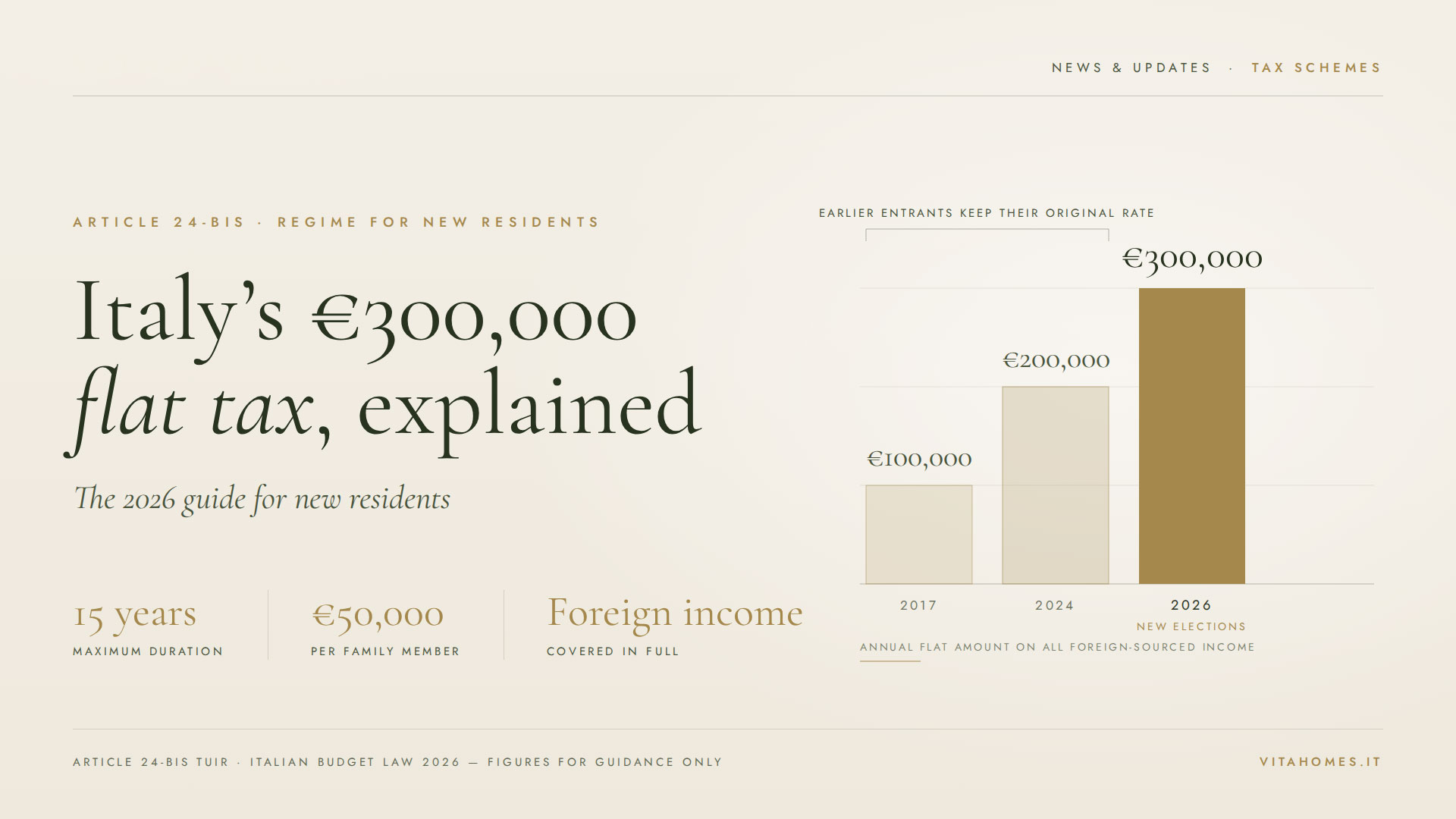
The regime forfettarioper neo-residenti, set out in Article 24-bis of the Italian tax code, allowsqualifying individuals who move their tax residency to Italy to pay a singleannual flat amount on all foreign-sourced income, regardless of how much thatincome is. Introduced in 2017 at €100,000 per year, it was raised to €200,000in August 2024 and, under the 2026 Budget Law, to €300,000. Family members canbe added, now at €50,000 each rather than the previous €25,000.
What the €300,000 flat taxcovers
Even at the higherprice point, the regime remains comprehensive. In broad terms it provides:
– A single annual payment that replaces ordinary Italian tax onall foreign-sourced income — including dividends, interest, capital gains andrental income — irrespective of amount.
– Exemption from Italy's wealth taxes on foreign real estate andfinancial assets (IVIE and IVAFE).
– Exemption from Italian inheritance and gift tax on foreignassets.
– A window of up to 15 years, with earlier entrants grandfatheredat the lower €100,000 or €200,000 rate they originally elected.
The 2026 increase — andwho is grandfathered
The move from €200,000to €300,000 applies to new elections, not to those already inside the regime.Individuals who established residency and elected in before the 2026 increaseretain their original rate for the remainder of their 15-year window. For anyonestill weighing a move, this changes the calculus: the decision now hinges farmore on long-term residency intent than on chasing a lower headline number.
Why now: the end of the UKnon-dom regime
The timing is notincidental. The UK abolished its non-dom regime in April 2025, replacingdecades of remittance-based treatment with a short tax-free period followed byworldwide taxation. Italy has positioned itself as the most permissivemainstream European alternative — more generous in both duration and scope thancomparable French, Spanish or Portuguese arrangements. Estimates suggestseveral thousand HNWIs evaluate or execute a move to Italy each year, althoughthose who formally elect into the flat tax remain a small, highly selectivegroup rather than a mass migration.
The crucial limit:Italian-source income
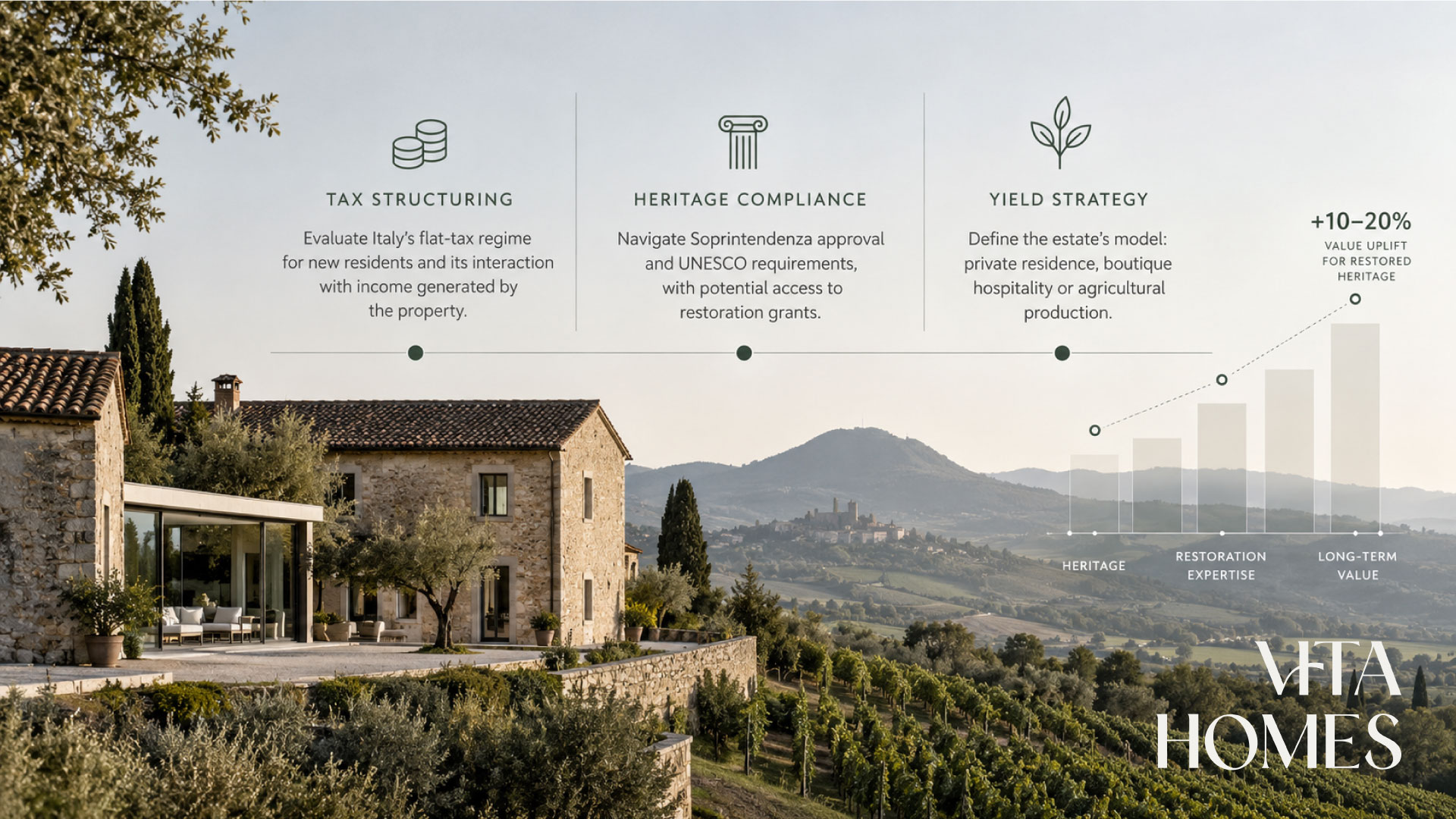
The flat tax is agateway, not the whole plan. It shields foreign income and assets, but incomegenerated inside Italy is taxed under ordinary Italian rules. That distinctionmatters enormously for anyone buying an estate that will earn money locally — througha vineyard, an olive-oil operation, boutique hospitality or rentals — becausethat Italian-source income falls outside the flat tax. In practice, structuringthe property and its activities is often as important as the headline rateitself.
Is the flat tax right foryou?
The regime tends tosuit individuals with substantial foreign-sourced income who value Italy'slifestyle, stability and heritage and who intend to make it a genuine long-termbase. For those buyers, a restored villa in Tuscany or Umbria is not only a homebut the anchor of a considered residency strategy. Because the interactionbetween the flat tax, property income and heritage rules is genuinely complex,professional Italian tax and legal advice is essential before making anydecision.
Discover what VitaHomes isbuilding next
The philosophy behindevery VitaHomes residence is the faithful restoration of Italy's builtheritage, paired with contemporary living and a complete ecosystem of servicesthat makes ownership effortless. Explore our upcoming projects and see howheritage becomes home.
Sources &disclaimer. Figures reflect Italian 2026 Budget Law provisions on Article24-bis and are drawn from the Henley & Partners Private Wealth MigrationReport 2026 and publicly available Italian tax summaries. This article isprovided for general information only and is not tax or legal advice; alwaysconsult a qualified Italian professional.
More news
View all
Prime European Property in 2026: Buyer Shifts, Currency and Luxury Trends
Europe's prime residential markets are being reshaped by three forces at once: a changing mix of international buyers, the quiet but powerful influence of currency, and an evolution in what wealthy purchasers actually want from a home. Drawing on Knight Frank's July 2026 European research and Sotheby's International Realty's luxury outlook, here is how the picture looks.
Heritage as a Working Asset: Restoring Historic Italian Estates in 2026
The most significant shift in Italian heritage property in 2026 is not about price — it is about purpose. Historic estates are no longer bought purely as private retreats. Increasingly, restoration is framed as an entrepreneurial strategy as much as an aesthetic one, and that changes everything about how these properties are chosen, restored and owned.

contact us
.avif)